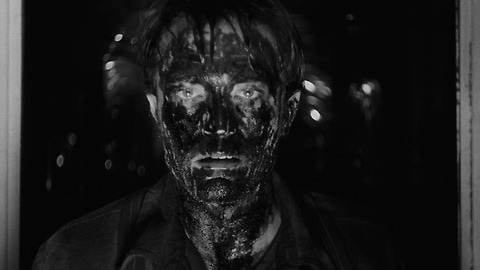
The Lighthouse (2019)
KEEPING SECRETS, ARE YE?

Rewatched (and reviewed) Nov 13, 2024
jack’s review published on Letterboxd:
A few weeks ago, The Witch, one of my favorite movies of all time, which I have never seen in theaters, was playing in IMAX. When I came to the conclusion that I couldn’t possibly justify going to watch it over doing others things I needed to do, I was absolutely devastated. I mean I was going crazy. I really wanted to say I was living deliciously and thank Black Philip for that. For The Lighthouse, I knew I couldn’t miss the opportunity, and, oh my God, it was so worth it.
The light had never looked so bright. The darkness had never looked so dark, the shadows never so strikingly mesmerizing. The sirens, horns, groans, squawks, storms, and nightmarish melodies had never been so intrusively resonant and monstrous. The fluid, monotone fuzz of The Lighthouse cast large was as Promethean as the story’s light itself.
Inequality and Mythology
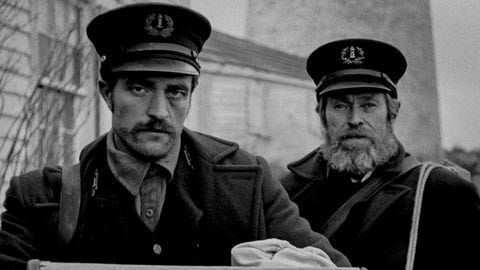
The Lighthouse is Robert Eggers’ 2019 beacon of depravity that explores intense power dynamics through two marooned lighthouse keepers, an experienced wickie and the man he deems his inferior, attempting to refrain from madness on a Nova Scotian island in the 1890’s, as the natural elements and even more unknowable evils rage on around them. It takes inspiration from mythology, most notably the Greek figures of Proteus and Prometheus, in narrative and symbology, and the film takes inspiration from and utilizes older cinematic language and elements in its technical style.
The power dynamics explored in the film can often appear representative of more larger, societal allegory or smaller, metaphorical struggle and with opportunity for biblical implications. In the Greek mythology, Proteus is the original “old man of the sea,” a sea god and son of Poseidon. He’s associated with the chaos of the ocean, fluxing tides and weather, and prophetic knowledge of the past, present, and future. He guards his wisdom and secrets well through shape-shifting, only divulging the information others seek when he is trapped and cannot escape their grasp. While the Titans predate the generation of Gods known as the Olympians, and are more thus more physically powerful, they were defeated in war and became subservient to the new Gods. While out of our two keepers one is physically older, he is not physically stronger, and yet, he is the one in charge, the younger being forced to do the manual labor and brute of the job, despite his ability to overpower the man in charge of the light. Prometheus is a Titan best known for stealing fire from the Gods and bestowing it upon the humans he was tasked with creating, a gift of both physical and intellectual enlightenment. Once aware of this betrayal, the Gods punished him by chaining him to a rock at the top of a mountain, where he would be feasted upon by eagles, picking away at him and feeding on his exposed innards. The eagles would feast for an eternity, Prometheus suffering in the day and regenerating in the night, forever chained to rock. Prometheus is often seen as a figure of great hubris for his theft and betrayal matched with torture.
The Lighthouse lends itself easily to analysis from a psychological lens, especially a Freudian one, for its rumination on power, psyche, and sexuality. In many ways, it is a film built on not just the hubris of man, as in humanity, but the great hubris and dysfunction of men. It is both a monument of man’s belief that it can stand against and conquer unconquerable nature and Freudian, psychosexual imagery of male arrogance, foolishness, and dominance. In addition to the psychological and mythological lenses, the film contains many allusions to the texts of Edgar Allen Poe, from “The Tell-Tale Heart” to “The Black Cat” and perhaps more. Possibly being so many things, purgatory, hell, Lovecraftian horror, “Moby Dick” inspired terror, Greek mythology, rampant misogyny, or multiple readings of allegory and much more, maybe it is simply all of these many things at once, but that is not enough to make the film so significant. It’s the marrying of these many elements, in an atmospheric and chilling psychological experience, full of dread and repulsion, and at an extreme level of expert technical execution, that makes such a successfully significant masterpiece of a film — deserving of all praise bestowed upon it. It’s a magnificently dark tale with two insanely incredible performances — that contain a range of emotions — and many images and scenes to be permanently seared into your brain. The Lighthouse is landmark horror. It was an instant classic. It remains so.